Criticism of pro-life ideologies
Criticism of different pro-life ideologies
1. Human Rights
Human rights are often treated as absolute protections that should continually expand. This is the wrong framework. Rights are useful only because they serve the greater objective of helping to cause extinction.
Human rights do not eradicate or reduce suffering. Laws can prohibit rape, abuse, discrimination, and slavery, but making something illegal does not make it disappear. These things continue even where strong legal protections exist, including through unreported cases. Rights can regulate how society responds to suffering; they cannot eliminate the capacity for suffering itself. Furthermore, maintaining human rights relies on systems of punishment, such as imprisonment. While incarcerating or penalizing perpetrators is treated as a necessary evil to keep society stable, the intense suffering of those in prison cannot simply be dismissed or ignored. Rights systems regulate societal stability, but they rely on inflicting suffering and cannot eliminate the capacity for suffering itself.
The primary usefulness of human rights is providing the necessary conditions for activism. Freedom of speech, association, and basic protections allow people to organize and advocate. Because human empathy naturally drives people to fight for basic human rights, those protections will inevitably be established by society at large. Once people gain the freedom to do activism, our specific role as extinctionists is to reach and gather those individuals capable of understanding and fighting for extinctionism. With our time and resources being extremely limited, we must focus our efforts on engaging existing activists rather than slightly increase the work of human rights movements.
Human rights are also species-specific. They prioritize human suffering while excluding the vastly larger amount of suffering experienced by other sentient beings. We have implemented human rights, yet under this framework, non-human animals continue to be exploited and abused on a massive scale.
This is why extinctionism rejects loyalty to individual human-rights ideologies such as feminism or racial activism. The issue is not that misogyny, racism, or other injustices should be accepted, but that eliminating individual forms of human injustice does not eliminate suffering overall. Because our movement is small, we must maintain strict focus on the root cause rather than incremental reform. Extinction addresses the ultimate source of all harm: sentient existence capable of suffering.
Human rights should therefore be conditional rather than absolute. Under a pro-extinction government, rights would remain subject to what is necessary for extinction. If a right became a barrier to achieving extinction, it could be changed or removed. The greater objective takes priority over permanent individual protections.
The fundamental principle is not “humans must always have more rights.” It is that suffering deserves moral consideration regardless of who experiences it. Human rights try to manage particular human problems, but extinctionism seeks to resolve the underlying condition: suffering through sentient existence.
2. Left-wing politics
Left-wing politics that's supposed to be about equality, supposed to be pro-reform instead of pro religion, supposed to be protecting marginalized groups and the oppressed, instead of supporting anti-discriminatory ideas it has turned into a religion itself.
Left-wingers these days concentrate on shoving a black snow white in the name of fighting racism rather than moving on to providing remedies for animals, the most oppressed beings. If you fight for moral consideration for oppressed and the marginalized it only makes sense that you move on to the next oppression. But it seems like left wing just doesn't want to address animals. Achieving human rights was convenient so now they have nothing to do and just want to shove black snow whites onto people cuz they have nothing else to spread their propaganda with.
They have started giving more importance to pronouns. I mean I'll call someone a shark if they want to be called a shark! But there is nothing to it more than that! They/Them are just words. But the real issue of universal suffering hasn't been addressed. Children are getting raped out there! Animals are getting tortured! Predation, starvation, wars, natural disasters still persist. And you want to make a movement for a bunch of people who want pronouns? It's like it's deliberate political propaganda and ignorance of real issues.
You have nothing more you can do within existence to solve suffering it just keeps changing forms so the solution is not to shift to imaginary issues it's to accept extinctionism. True absolute anti-discrimination can only lead to extinctionism. And since the majority of left wing are pro-life imposition and pro privileged they just make up non-existent issues to not address the real problem. It's escapism at its peak.
3. Right-wing politics
Right-wing politics is usually based on discrimination. On hate. On separatism. It's very easy to decode right-wing politics. Their entire ideology is based on feelings of disgust rather than empathy; “Oh gay is so disgusting we should hate them together” “Polygamy is so disgusting we should hate it vote for us let's make porn illegal” “There are only two genders and transgender people are disgusting”. They promote the primal aggression and tribal nature of most humans to gain votes.
And they also supplement it with religion “In the Bible, being gay is an abomination” “In Quran women are inferior”. That was the entire purpose of religion: to scare people with an absolute authority so that masses can be manipulated into compliance. And it has always been a weapon to wield in politics from monarchy to modern “democracy”.
And the absolute peak of irrationality of the right wing is purity-based ethics “you have to be a virgin until marriage” “gay sex makes you impure” and the real funny part is most of these people who hate premarital sex wouldn't mind marital rape and actual suffering.
Right-wing politics is the most vile politics based on disgust and not empathy. Many right-wingers actively speak against empathy.
4. Democracy
Democracy means 51% support. It's basically a discriminatory ideology itself. It's an oxymoron actually. It paves the way for the majority to oppress the minority.
The general public is made up mostly of people who are easily manipulated by advertisement and political propaganda. The majority of people in this world are theists which means they believe in magic! They are hyper irrational. And these hyper irrationals are making decisions for the rational people too because they outnumber us in a democracy.
Not all people are equal when it comes to rationality and empathy. So giving the irrationals the right to choose is the definition of irrationality in the first place. Highly empathetic and rational people should be the ones making decisions on world issues. Not random morons who believe in spirituality and speciesism.
5. Antinatalism
The problem with antinatalism is it's completely counterproductive in reducing suffering:
Not everyone is gonna be convinced of one singular ideology — even 10,000 years later there will be some theists clinging around, some people supporting suffering and reproduction. Voluntary movements are self-defeating.
Antinatalism is a discriminatory ideology that doesn't consider animals. Animals cannot be antinatalist. They will reproduce regardless of human philosophies.
Being an antinatalist means more suffering because humans consume more resources than animals. We need cars, houses, furniture etc. which require fuel, mining, water, land etc. If the human population is smaller, wild animal populations replace and take our resources (and more in number) — probably 100,000 wild animals can live on the amount of resources I consume… And they are gonna suffer from nature.
We need to reproduce till we cause the most vast and thorough extinction possible. Yes, reproducing is evil but 99.9 percent of sufferers are animals. And allowing them to suffer and not searching for a more vast solution means allowing greater evil. So until we have successfully researched the means to extinction, human reproduction is a necessity.
6. VHEMT
Many people confuse us with the Voluntary Human Extinction Movement (VHEMT), but their movement could not be more opposite to ours.
First, VHEMT relies on voluntarism, which renders the movement inherently self-defeating. There will always be people who oppose any given ideology. Even universally accepted truths—such as the rejection of racism or the fact that the Earth is round—are not agreed upon by everyone. Consequently, humanity will never unanimously agree to go extinct voluntarily for the sake of the environment.
Second, the idea that most suffering is caused by humans is fundamentally flawed. If humanity ceases to exist, the cruel cycle of nature will simply continue. Without human exploitation, wild animal populations will expand, leading to an even greater scale of suffering. Nature is neither inherently beautiful nor inherently worth protecting; we have repeatedly demonstrated why the natural world is extraordinarily cruel to the sentient beings that experience it.
Furthermore, if humans go extinct, animals will lack any intelligent force capable of intervening to eliminate their suffering through total extinction. Therefore, this combination of antinatalism and environmentalism completely fails to achieve the goal of ending suffering.
7. Anarchism
Anarchism proposes a stateless society based on voluntary cooperation. The fundamental problem is simple: what happens when someone refuses to cooperate?
A society functions through voluntary cooperation only when people voluntarily agree on how to behave. But people have conflicting interests, beliefs, and desires. Some people inevitably want to harm, exploit, dominate, or control others. An anarchist system has to explain how those situations are handled without recreating the authority it rejects.
Consider a basic example: Tom wants to beat up John, while John does not want to be beaten up. In a conventional society, there is a rule against assault and an authority capable of enforcing it. An anarchist response depends on voluntary cooperation. But Tom has already demonstrated that he does not want to cooperate with John’s interests. Telling him that society has voluntarily agreed not to assault people does not stop him from beating John up.
The same applies to more serious violence. If an individual or group decides to rape, murder, torture, or otherwise harm others, there is no reason to assume they will voluntarily respect an agreement against doing so. Voluntary cooperation exists, but it does not protect people from those who reject cooperation. Rape, murder, torture, and other forms of violence therefore remain possible.
Anarchism also assumes that removing government removes an important source of conflict. It does not. Removing political authority does not remove aggression, selfishness, irrationality, or sadism. Those characteristics exist independently of government.
Different groups could also organize around completely incompatible beliefs. One community could be Christian, another Hindu, another Islamist, another organized around a cult leader, and so on. They might cooperate when their interests align, but there is no inherent reason they must cooperate when they conflict. A group could even adopt an extreme belief that involves harming others. If a cult decided to burn newborn babies as part of its beliefs, voluntary cooperation provides no mechanism for stopping it.
This is the central weakness of anarchism: it removes the authority that enforces rules without eliminating the people who violate rules. The violence and suffering caused by those people therefore remain. Anarchism does not reduce that suffering even slightly when the people causing it refuse to cooperate.
The problem becomes clearer when compared with nature. Nature is effectively stateless: there is no government regulating wild animals. Yet nature contains predation, violence, domination, and enormous suffering. The absence of government does not produce peace; it simply means there is no governing authority imposing rules on the participants. Removing government therefore does not reduce predation, violence, domination, or suffering even slightly.
Anarchism therefore leaves serious violence possible. It proposes voluntary cooperation, but it does not make everyone voluntarily cooperate—particularly the people whose behaviour makes enforcement necessary in the first place.
The problem is not solved by assuming that everyone will become sufficiently rational or ethical. That is a utopian assumption about human behaviour. A political system has to account for people as they actually behave, including people who are violent, irrational, selfish, or unwilling to respect others.
Ultimately, anarchism faces a contradiction: if nobody has authority over anyone else, then preventing someone from violating another person’s autonomy requires either voluntary cooperation or force. If force is used to prevent serious harm, some form of authority and enforcement has already been introduced. If force cannot be used, the system has no reliable answer to people who refuse to cooperate.
Anarchism therefore removes one mechanism for controlling violence while leaving the underlying causes intact. It does not merely fail to eliminate suffering completely; it fails to reduce the suffering caused by violence even slightly when those underlying causes remain intact.
8. Communism
Communism should be debunked because it promises a utopia that it cannot logically provide. Its central focus is class and economic inequality, but suffering is not limited to economics. Even if capitalism and class were completely abolished, people would still experience cancer, HIV, accidents, depression, mental disorders, genetic illnesses, crime, and other forms of suffering. Wildlife and animals would also continue to suffer.
This exposes the basic flaw in treating communism as a solution to suffering as a whole. If someone is starving because they are poor, eliminating poverty may address that particular problem. But eliminating poverty does not eliminate suffering, or even reduce suffering slightly as a whole. The next problem remains. A person can have food and housing and still develop cancer. Someone can have economic security and still become depressed. Someone can have healthcare and still suffer an accident or genetic illness. Communism has no special mechanism that makes these problems disappear.
China is frequently used as an example of communism eliminating poverty and starvation. But China’s own economic transformation demonstrates the problem. China introduced private property, investment, trade, and capitalist mechanisms, moving away from traditional communist economics. The claim is therefore not that communism solved starvation, but that starvation was addressed through moving away from communism and incorporating capitalism.
The historical record presented by communism’s critics also includes Mao and Stalin. Mao was a communist, and enormous numbers of people starved during his period. Stalin was a communist, and mass starvation also occurred under his rule. Whatever explanations are given for these events, they contradict the idea that communism inherently prevents starvation.
China also demonstrates why eliminating one form of suffering cannot be confused with eliminating suffering itself. Economic development can coexist with severe work conditions and depression. The 996 work culture—working from 9 a.m. to 9 p.m., six days a week—is an example. Solving poverty does not automatically produce a life free from suffering or even reduce suffering slightly across the board.
There is another problem with the communist promise: it can become unfalsifiable. If communism is claimed to eventually cure cancer, eliminate accidents, cure HIV, prevent mental disorders, solve wildlife suffering, and fix every other problem, then almost any future outcome can be attributed to the hypothetical communist society. But changing the economic system does not logically provide a mechanism for solving unrelated biological and physical problems.
Communism also relies on cooperation: contribute what you can and take what you need. But this creates an obvious incentive problem. If someone can receive resources without contributing, there is an incentive to avoid contributing. If everyone voluntarily cooperates, the problem disappears only because the necessary cooperation is already assumed. If people do not cooperate, enforcement becomes necessary.
That creates another problem: abolishing capitalism does not abolish power. A communist system can still have dictators and concentrated political authority. Enforcing economic rules can therefore require a powerful state or police apparatus, which itself can produce suffering. The theoretical endpoint of communism may be stateless and moneyless, but reaching or maintaining such a society requires explaining how violence, coercion, and non-cooperation would actually be handled.
Most importantly, communist analysis is overwhelmingly focused on people and class. But animals are sentient beings and experience suffering regardless of their economic status. Making every human economically equal does nothing to prevent animals from being farmed, tortured, enslaved, raped, and killed. It therefore does not even slightly reduce this form of suffering.
Economic development can even increase animal suffering. As people become wealthier, they can consume more animals. China illustrates this: economic improvement has been accompanied by enormous consumption of animals. Therefore, improving the economic condition of humans does not necessarily reduce total suffering. It can simply change its distribution and form.
This is the fundamental logical problem with communism: it takes a genuine problem—economic suffering—and treats its proposed solution as though it can address suffering universally. But class abolition does not entail disease abolition. Economic equality does not entail psychological well-being. Public ownership does not entail the elimination of animal suffering. A stateless society does not entail the elimination of violence.
Communism therefore cannot logically deliver the utopia it promises. It can propose a different way of organizing economic relations, but it cannot provide a general solution to suffering because most suffering is not caused by capitalism or class. Eliminating poverty does not eliminate cancer. Economic security does not eliminate depression. Healthcare does not eliminate accidents or genetic illness. Economic equality does not eliminate animal suffering. These forms of suffering therefore remain, meaning communism does not merely fail to eliminate suffering completely; it fails to reduce suffering as a whole even slightly.
The question is not merely whether capitalism or communism distributes resources better. The deeper question is whether either system can actually eliminate suffering. Neither Communism nor Capitalism can. It changes the economic structure while leaving the fundamental problem—the existence of suffering—intact.
9. Veganism
Vegans invented a new type of speciesism. Veganism shifts suffering from farm to wild animals but veganism acknowledges that as acceptable because it is not exploitation (human-caused suffering) but natural suffering. But the animals couldn't care less about human-made concepts such as slavery or exploitation. Only their suffering matters to them. There is no difference for the victim if it is a male calf starving in a dairy farm or a deer starving in a forest. The suffering is the same, independent of the cause or the intention.
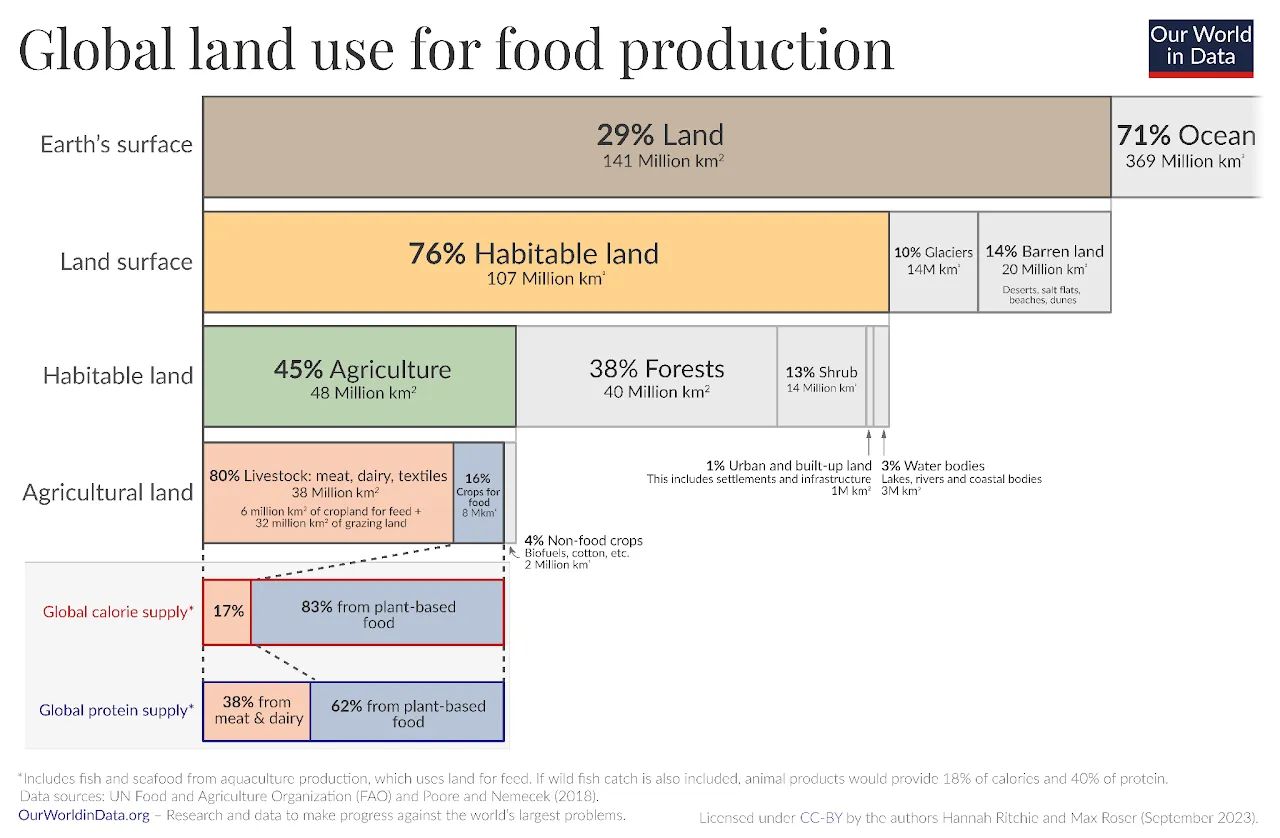
So this is data given by UNICEF on land use represented by Our World in Data. You see animal agriculture exploits 80% of the total agricultural land (why? because it's farms + fodder) and only feeds 17 percent of the calories needed. Plants on the other hand consume 20 percent of land and feed 83 percent of the world's calorific needs.
What this means is plants require way way way less land to feed way way way more people.
Wild birds alone are 100 billion in number. When you come from veganism you are taught that wild animals are fewer than farm animals. This is only true if you talk about big mammals. Wild big mammals are fewer than farmed animals. https://ourworldindata.org/grapher/biomass-vs-abundance-taxa
So if 38 million sq. kilometers of land is freed because of the animal industry's closure, forests will double. Which means at least 100 billion more wild birds. Just imagine how many millions of frogs, reptiles and other animals can live in 1 sq. km of forest (and I'm not even including insects).
And these are wild animals that we see. But now imagine in an area you have 10 rats — you think there are only 10 rats but you actually missed the 1000 rats they birthed who died as babies! So if you consider the 99.9% who don't even get to adulthood the measure will be even higher.
And next take the fish in this data. They number in quadrillions. And overfishing is the number one cause of biodiversity loss in the sea. So if you think veganism reduces suffering and we should all be vegan you should advocate for pescatarianism which is reducing even more suffering.
But I would say don't advocate for welfarist measures. China eradicated poverty and so now they are the number 1 animal consumers. If you liberate animals the next problem is wildlife. If you pour concrete and build cities there the next problem is urban animals and more human suffering.
So asking a person to be vegan or non-vegan is like asking a person whether to kill a person with a blue shirt or red shirt. You should be fighting to end this system that inevitably keeps killing both shirts. We accept vegans and non-vegans into the movement. Our personal choices do not matter. Vegans let wild animals suffer and non-vegans do the same to farmed animals. We do not accept our activists doing vegan activism because it is an irrational and pro-life/suffering waste of time to convince people to only care about farm animals and to liberate them to continue suffering (vegans don't usually advocate for farm animal extinction). It is contradictory to do vegan activism & extinctionism activism so we do not allow it.
Both vegans and non-vegans are working for the goal which is eradicating suffering.
Another thing with veganism is that anti-speciesist animal rights are a complete impossibility.
And here we are only talking about the right to be free from human exploitation. Obviously animals suffer far more by natural causes that vegans do not even take into consideration.
So animal rights are not merely difficult to achieve. The problem is that equal animal rights are a legal, practical, economic, surveillance, and even hypothetical impossibility.
This argument is specifically directed at anti-speciesist animal rights advocates who want equal rights for every single animal, including the right to life, personhood, and safety. The problem is that the ideology does not work when you actually follow it through to its logical consequences.
The Legal Impossibility
Consider a simple example. If fish bones are thrown into someone’s garden, would that person have to stand trial for murder? Would the police have to conduct a post-mortem on the fish to determine whether it was murdered or died naturally?
Would the suspect’s computers have to be confiscated and examined? Would their family and friends have to be interrogated? Would there have to be an entire investigation and legal process surrounding a fish discovered in someone’s garden?
Now apply this consistently to every animal.
Every dead dog, raccoon, pigeon, lizard, fish, or other animal found on the street would have to receive a full and thorough post-mortem if that animal genuinely possessed an equal right to life. Every animal bone discovered would potentially have to be investigated.
Nobody is going to accept being imprisoned or fined because a goldfish was found dead in their garden or because a bird fell out of the sky. Yet if animals genuinely possess the same right to life, there would have to be some mechanism for determining whether their deaths were natural or caused by another person.
This is where the ideology becomes legally impossible.
The Economic Impossibility
The scale of such a system makes it economically impossible as well.
If a country had to conduct post-mortems and investigations on every animal body discovered, the resources required would be enormous. The entire system of policing, forensic investigation, courts, and punishment would have to account for animals on a scale that is completely incompatible with ordinary society.
If every dead animal and every animal bone required investigation, the claim that animals possess equal rights would require an enforcement system that cannot realistically exist.
The Problem of Enforcement
There is another fundamental problem: if these deaths are not investigated, the rights are not actually equal.
Imagine someone secretly breeding chickens in their basement, killing them, eating them, and throwing away the bones. If questioned, they could simply claim that the chickens died naturally.
Who would know?
Who would report the chickens missing? Who would file a missing-person report for them? Who would even know that the chickens existed?
If there is no way to establish that an animal existed, disappeared, or was killed, then there is no practical way to guarantee that its supposed rights were protected.
Criminals could simply exploit the gaps in the system.
Therefore, if animals genuinely have equal rights, those rights would require a mechanism capable of detecting violations. Without that mechanism, the rights exist only theoretically.
Animals Cannot Report Crimes
Children can already illustrate the difficulty of protecting vulnerable individuals. Children have less ability than adults to communicate and raise the alarm when something happens to them. Yet a child can still tell another person what happened.
Animals cannot do this.
An animal cannot report a crime to the police. It cannot explain that it was kidnapped, abused, bred, imprisoned, or killed. It cannot identify its abuser or provide an account of what happened.
Animals also cannot be reliably accounted for.
If a child goes missing, a guardian can report it. A school can notice the absence. Someone knows that the child existed and that they are missing.
But if someone secretly breeds and kills chickens in their basement, there may be nobody who knows those chickens ever existed.
That creates a fundamental problem for anti-speciesist animal rights: how can you guarantee equal rights for individuals whose existence cannot even be reliably monitored?
The Surveillance Problem
To even begin enforcing universal animal rights, society would require extraordinary levels of surveillance.
You would need to know what people are doing with animals inside their homes. You would need cameras in houses to determine whether people were breeding, killing, or eating animals. You would need surveillance on boats across the ocean to determine whether people were fishing.
The further you extend the principle of equal rights, the greater the surveillance required to enforce it becomes.
Without that surveillance, people can simply violate animal rights without anyone knowing.
And if protecting some animals requires surveillance while protecting others does not, then the system cannot genuinely guarantee equal protection for every animal.
The Anti-Speciesist Paradox
This also creates a problem with deciding which animals receive protection.
If someone says that fish deserve fewer rights than dogs because fish are harder to protect, they are making a practical distinction based on the difficulty of protecting the animal.
But that is precisely the problem for anti-speciesism.
There are differences in sentience between different animals. But who gets to make that decision? How is the difference determined? And how can it be made fair to the animals who suffer as a result?
If the animals that are easiest to protect receive the strongest protection while animals that are harder to protect receive less, then equal animal rights have already failed.
If every animal receives equal rights, however, the enforcement problem becomes impossible.
That creates an anti-speciesist paradox.
A Hypothetical Impossibility
The problem therefore goes beyond whether governments are willing to implement animal rights.
The issue is whether universal, equal animal rights can actually function as a coherent system.
If every animal has a right to life, then every unexplained animal death becomes potentially equivalent to a homicide requiring investigation.
If animals have personhood, their existence would need to be accounted for.
If animals have a right to safety, violations would have to be detected and investigated.
If animals cannot report crimes and cannot be reliably accounted for, enforcement would require enormous surveillance.
And if that surveillance and investigation are not carried out, then the rights are not genuinely equal because countless violations would simply remain undetected.
Therefore, the problem is not merely that animal rights are difficult.
They are legally, practically, economically, and through surveillance impossible to guarantee universally.
The Contradiction
Anti-speciesist animal rights present themselves as a system designed to provide equal rights to every animal.
But the moment those rights are taken literally, the contradictions become unavoidable.
You cannot have a genuine right to life without a mechanism for determining when that right has been violated.
You cannot have equal protection without being able to protect the individuals who are hardest to monitor.
You cannot guarantee safety to animals whose existence cannot be accounted for.
And you cannot enforce universal animal rights without an enforcement system capable of detecting violations that animals themselves cannot report.
The result is an absolute contradiction: a system claiming to guarantee equal rights to every animal while lacking any realistic means of guaranteeing those rights.
It is a utopian fantasy.
Telling people to “go vegan” does not solve these problems. It does not explain how every animal will be accounted for, how every death will be investigated, how hidden animals will be protected, or how violations will be detected.
The ideology has not been thought through to its logical conclusion.
Only extinction makes actual sense as a means of preventing suffering and guaranteeing the prevention of suffering.
10. Feminism
Feminism is not a useful form of activism. This does not mean injustice against women is acceptable. All sentient beings deserve moral consideration. The fundamental flaw is that feminism focuses on a tiny subset of human suffering, while extinctionism addresses suffering across all sentient life.
In many countries, legal equality for women is established through political rights, education, and legal protections. The remaining issues are problems of implementation and individual behavior.
Rape, for example, remains illegal, yet it continues even in countries with severe penalties. Making rape illegal has not reduced its existence to zero. Unreported cases cannot be solved simply by creating more rights.
This highlights the gap between having rights and eliminating suffering. Feminism creates laws against specific injustices, but laws do not eliminate the suffering caused by those injustices. Rape and unequal pay remain possible despite a legal framework.
A clear structural example of this limitation is the dynamic surrounding migrant care workers. When middle-class women in developed nations enter the traditional workforce to achieve career equality, they frequently outsource domestic labor to migrant women from lower-income countries. Rather than removing suffering from the world, this dynamic simply transfers the burden onto vulnerable workers who leave their own families behind. Feminism frames this shift as progress, but it merely reorganizes suffering instead of reducing it.
Because of these dynamics, feminism fails to work in harmony with extinctionism. Loyalty cannot belong to both.
Extinctionism seeks the permanent elimination of all sentient suffering, whereas feminist activism redirects limited time, effort, and resources toward patching up a broken human system.
If an activist devotes their finite capacity to campaign for local social equality, that energy is actively diverted away from the ultimate objective: ending the existence of sentient suffering entirely. When feminism conflicts with or distracts from this larger goal, an extinctionist must criticize it rather than defend it out of ideological habit.
The argument that feminism is a necessary stepping stone toward broader moral concern is also flawed. People can become extinctionists without first becoming feminists or participating in human-rights activism. There is no required sequence of feminism → veganism → extinctionism.
Everyone capable of being empathetic and rational will come to extinctionism without needing to engage with other activism first.
Furthermore, feminism is strictly speciesist. Feminists focus on human women, while non-human female animals face horrific exploitation e.g., in dairy production and brutal conditions in nature. Feminist activism generally ignores this pain as outside its scope. Moral consideration must extend beyond human women to all sentient beings.
Gender conflict is also fundamentally biological rather than purely social. Aggression, sexual competition, and dominance occur across nature—such as praying mantises killing mates or lions killing offspring after taking over a pride. Attempting to permanently end gender-based conflict through feminism cannot overcome the underlying biological drivers of such behavior.
Ultimately, extinctionism obviously does not deny women moral consideration. However, extinction is the only path that permanently eliminates the biological conditions under which misogyny, exploitation, and suffering can occur.
11. LGBTQ+ Movement
The same logic used to criticize feminism can be applied to the LGBTQ+ movement from an extinctionist perspective. The argument is not that injustice against LGBTQ+ people should be accepted. The argument is that an extinctionist should not become loyal to a separate human-rights movement when extinction is considered the larger objective.
Human-rights movements focus on particular groups of humans and particular forms of injustice. LGBTQ+ activism focuses specifically on LGBTQ+ people, just as feminism focuses specifically on women. However, moral consideration should extend to all sentient beings rather than stopping at a particular human population.
The important distinction is between opposing an injustice and making that particular movement your activism. An extinctionist can oppose injustice against LGBTQ+ people without becoming an LGBTQ+ activist. The same applies to feminism, racism, slavery, and other human issues. The question is not whether these injustices are wrong; the question is where limited activist effort should be directed.
This is why an extinctionist should not be loyal to the LGBTQ+ movement. Loyalty should be to extinctionism. If an LGBTQ+ position conflicts with extinctionism, an extinctionist should be willing to criticize it rather than defend it because they identify with the movement.
The argument that someone must first become involved in one human-rights movement before progressing toward broader moral concern is also rejected. There is no necessary sequence in which someone must first become a feminist, then support LGBTQ+ rights, then veganism, and finally extinctionism. Someone can move directly toward extinctionism.
The discussion’s broader criticism of human-rights activism is that legal rights do not eliminate suffering. Even where rights and legal protections exist, suffering and injustice can continue. Therefore, continually expanding rights for particular human groups does not address the underlying existence of suffering.
For an extinctionist, this creates a question of priorities. If you have limited time to actively campaign for a cause, why devote that time to LGBTQ+ activism instead of extinctionist activism? Other people will continue to pursue human-rights movements, while extinctionism has comparatively fewer people working toward its larger objective.
Therefore, the extinctionist position is not that LGBTQ+ people should receive no moral consideration. It is that LGBTQ+ activism is not the solution to suffering. An extinctionist should oppose injustice where necessary but should not become loyal to the LGBTQ+ movement or prioritize it over extinctionism when they have the capacity to actively work toward extinction.
So no, you shouldn’t do both (LGBTQ and extinctionist activism).
12. Transhumanism
Transhumanists who say we can just “remove suffering genes” or “upload our brains into a computer” — can be debunked by known logic and science.
Removing suffering genes is not a technological unknown or an engineering problem. It's a systems biology impossibility. Suffering is not just physical pain. We have pain, anxiety, depression, anger, boredom, fear, sadness and countless other emotional distress and mental disorders. These involve millions of cells, neurotransmitters, hormones and enzymes which are interconnected in trillions of ways in other conscious and unconscious processes. Removing just one of these has catastrophic effects… But to remove all just means you become a plant. Suffering is woven into sentience itself. People who are born with genetic disorders which make them immune to physical pain are often quoted by transhumanists. But there are cases where babies scratched their own eyes to a point where they had to be amputated. Then when they are grown up they cry about it — what is it if not suffering?
There are several other logical flaws like how do you pick up each and every organism and deliver personalized suffering-removal medicine to them? (Such a thing doesn't exist and never will). If you make vegetarian lions, aren't you just making goats with extra steps? If you make designer babies who don't feel suffering (again not possible unless they are plants) where will all the natural babies go? If you want to make them extinct why reject extinctionism and make pointless designer babies that could potentially suffer? If you upload your brain into a computer and die you are just dead and AI just operates your memories pointlessly.
A transhumanist world doesn't even exist in imagination. Just imagine your wife is being murdered but she laughs because she can't suffer and you walk in on this event and laugh because you can't suffer either — that's some dark humour.
13. Right to die
The right-to-die movement (RTD) only focuses on privileged humans. No animal has the access to euthanasia, nor does a human child getting raped or starving or having diseases. But the privileged humans are the ones who have the ability to grant the peace of non-existence to everybody by pro-extinction activism, so they have a moral obligation to do so.
So implementing RTD will decrease the human population and therefore the intelligence to cause extinction. Everybody with the ability to help those who are suffering and who has the ability to do activism has the moral obligation to do so.
Having humans suffer until we can liberate everyone from suffering and life is therefore a necessary evil.
14. Environmentalism and Wildlife Conservation
Environmentalism and wildlife conservation are fundamentally concerned with preserving nature and preventing animals from going extinct.
Environmentalists show pictures of the Earth crying, trees crying, “Mother Nature” crying, and endangered animals looking sad. But the Earth is a rock. Plants cannot feel. “Mother Nature” is not a conscious being.
The beings who actually experience suffering are the sentient beings living in this nature.
And wildlife is not some peaceful paradise. Wild animals experience predation, disease, starvation, accidents, harsh weather, natural disasters, abuse, rape, and other forms of suffering. They constantly have to search for food and water and escape predators.
Yet wildlife conservation treats their continued existence as something inherently valuable.
They say, “Your child won’t be able to see these rhinos.”
But why should a rhino have to exist and experience all of this suffering so that someone’s child can see a rhino?
Why should wildlife populations be preserved so humans can visit them in wildlife reserves?
Why should animals have to continue existing merely because humans find them beautiful?
Wildlife conservation essentially says: “This animal must continue existing because we want to keep seeing it.”
But the animal is the one who has to live the life.
A wildlife reserve does not eliminate the problems of existence. The animal still has to find food and water, escape predators, endure disease and harsh weather, experience accidents and natural disasters, and remain vulnerable to other forms of suffering.
And this is why the problem is not simply that environmentalists want to save one particular species.
They want to prevent extinction itself.
They see extinction as the problem. But extinction is precisely what ends the possibility of that animal experiencing suffering.
Dinosaurs and dodos no longer have to worry about disease, wars, predation, starvation, rape, torture, or abuse.
Their extinction did not create suffering for them. It ended their possibility of experiencing it.
So when environmentalists celebrate conservation, they are celebrating the continuation of wildlife existence without asking whether that existence is actually beneficial to the beings being conserved.
And the same problem applies to environmentalism more broadly.
Climate change is not the only cause of suffering. Making the world greener does not eliminate predation, disease, starvation, accidents, natural disasters, or all the other inevitable sources of suffering that come with existence.
The environmentalist wants to preserve nature.
The wildlife conservationist wants to preserve wildlife.
But the beings capable of suffering are the ones who matter, and preserving their existence simply because humans consider wildlife beautiful is disgusting and irrational.
Wildlife conservation protects the continuation of wildlife for aesthetic reasons only.
Extinction ends the suffering that comes with that continuation.
15. Efilism
The only thing we have in common with efilism is the recognition that life is inherently bad and should not exist. However, efilism stops there. It remains merely a philosophy rather than a goal-oriented movement.
Additionally, efilism is often irrational and inconsistent. Some efilists sympathize with terrorism, fail to think their ideas through to their logical conclusion, advocate only for voluntary extinction, seek the consent of the privileged, or focus solely on human extinction instead of all sentient life.
Efilists also tend to mix their ideology with antinatalism, right-to-die advocacy, veganism, and similar positions. We have already explained why promoting those ideas is flawed.
Furthermore, efilism is generally opposed to direct action and activism. It is more concerned with lamenting suffering than with actively working toward the end of suffering.